What is dissociative identity disorder?
“If you have dissociative identity disorder (DID), you have two or more separate personalities that control your behavior at different times. DID, a mental health condition, can cause gaps in memory and other problems. Various types of psychotherapy can help you manage your symptoms.”
The numbers
- Estimates of how common DID is vary, and none of them is a count of diagnoses. The clinical reference this page cites puts dissociative disorders generally at 1% to 5% of the international population, with severe DID in 1% to 1.5% of that group — figures from community studies of people who meet the criteria, not of people who have been diagnosed. The same reference notes that someone may spend five to twelve years in treatment before a DID diagnosis is made, so the number of diagnosed cases is much smaller than the number of people the criteria would fit.
- It was called Multiple Personality Disorder until 1994.
- The average number of identities is two to four.
Watch: Dissociative disorders — causes, symptoms, diagnosis and treatment, from Osmosis.
In their words
Distressing, stigmatised, and a “brilliant adaptive coping mechanism”
“People with the disorder have been portrayed in movies and TV shows as sociopathic, dangerous and the punchline to many a joke. It is none of those things. As one of our experts, psychologist Adrian Fletcher, puts it: ‘We're a community that's been highly exploited and misunderstood.’”
Read the article (Los Angeles Times)
My life with dissociative identity disorder
“Diagnosis, in a way, was having a name for what I perceived to be something different about me. It provided a reason for my behavior and gave me something to work on. When you know what the problem is then you can work on a solution.”
Read the article (SANE)
Conquering each day with dissociative identity disorder
“It's like having a committee inside my head letting me know how they would handle things if they were ‘fronting’, or in control. In some ways, my biggest challenge is also one of my greatest strengths — the ability to see everything from multiple perspectives.”
Read the article (NAMI)
What the brain imaging shows
Compared with control groups, people with DID have been found to have smaller volumes in the hippocampus and the amygdala, and in parietal and frontal regions. Depersonalisation in particular has been associated with changes in the left amygdala and the junction between the amygdala and hippocampus. The occipital cortex and insula also appear to be affected, though what that means is not clear.
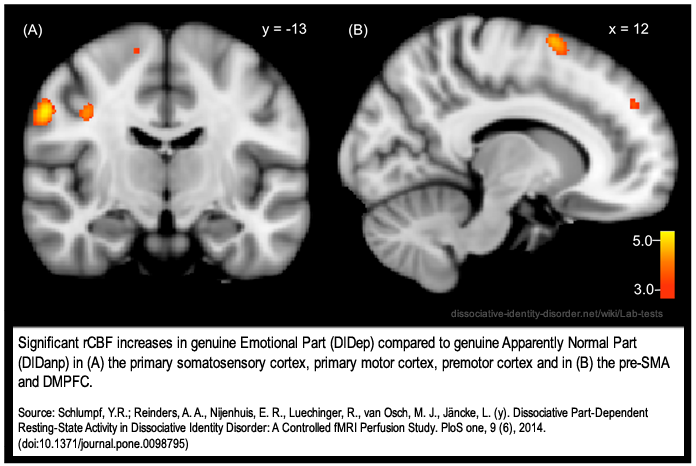
Two brain images side by side with a color scale beside them, warmer colors marking higher blood flow. The caption printed with the figure identifies where the differences fall: the somatosensory, motor and premotor cortex, and the pre-supplementary motor area and dorsomedial prefrontal cortex.
What the study was measuring is worth stating, because a picture of a brain invites more certainty than the finding supports. The researchers scanned the same people while they were in two different dissociative states, and compared blood flow between those states. So the differences are within one person, not between people with DID and people without — which is what makes the result interesting, and also what keeps it from saying anything about how anyone's brain compares to anyone else's.
How does treatment help?
With treatment, many people manage the major symptoms of DID and live well. Treatment is usually psychotherapy: the aim is to gain control over the dissociative process and, over time, to integrate the different parts of identity. It can be intense and difficult work, because it involves remembering and coping with past trauma. Cognitive behavioral therapy and dialectical behavior therapy are both commonly used, and hypnosis has also been found helpful.
There is no medication that treats DID directly. Medication can help with related conditions — an antidepressant for depression, for instance.
How to support someone who has DID
Written for the people around someone with DID, and condensed from Mind's guidance for friends and family.
- Be patient, and ask. They may not respond the way you expect. Ask what would help — and accept that they may not know, or may not be able to say.
- Listen without correcting. If they want to tell you about their experience, try to hear it rather than assess it.
- Ask about touch. Physical contact and closeness are difficult for some people. It is a thing to agree on, not assume.
- Expect identity alteration. You may be talking to different parts of someone at different times, and may need a different way of relating to each. Staying calm helps more than anything: being a steady presence matters even when they are upset or frightened.
- Learn the triggers. Knowing what brings on dissociation or flashbacks lets you help avoid them, or be ready.
- Look after yourself too. Supporting someone is genuinely hard, and finding your own therapist or your own people to talk to is not a luxury.
What this page is, and is not
This page explains the condition. It does not explain how to get care, and we have deliberately not tried to: how you reach treatment in the United States depends on your state, your insurance and your age, and guidance we wrote would be wrong for many readers and out of date for the rest.
Our old version of this page linked to ten guides from Mind, the UK charity — how to find an advocate, how to plan for a crisis, how to get a referral. Those describe a health service that does not exist where our readers live, so they are gone.
If you need help now, the crisis lines are here. For care, a doctor, a school counselor or a trusted adult is the place to start.
Books that portray DID
Fractured Mind, by Debra Bruch
One person's journey from violence to redemption, living with DID.
Recovery Is My Best Revenge, by Carolyn Spring
Collected essays on trauma, abuse and dissociative identity disorder.
A note from the team
We are not experts and do not seek to diagnose or act in place of professional psychiatric treatment. We are an organization seeking to raise awareness. If you have concerns about any of this material, please email us.
Sources
- Cleveland Clinic — Dissociative identity disorder (the definition)
- StatPearls, NIH National Library of Medicine — Dissociative identity disorder (the numbers)
- American Psychiatric Association — What are dissociative disorders? (the treatment section)
- Mind — Dissociation and dissociative disorders: for friends and family (the support section, condensed; the UK-specific guidance on this page is deliberately not reproduced)
- Schlumpf YR, Reinders AATS, Nijenhuis ERS, Luechinger R, van Osch MJP, Jäncke L — Dissociative part-dependent resting-state activity in dissociative identity disorder: a controlled fMRI perfusion study, PLOS ONE 9(6): e98795, 2014 (the figure, reproduced unmodified under CC BY-SA 4.0 via the Trauma and Dissociation Project)
- Reinders A. A. T. S. et al. — The neurobiology of dissociative identity disorder (the brain imaging section — could not be re-verified in September 2026, see the note on that section)