The parts of a neuron
- Neurons — nerve cells, the building blocks of the nervous system
- Dendrites — receive messages from other cells
- Cell body — holds the nucleus
- Axon — passes messages from the cell body on to other neurons, muscles or glands
- Myelin sheath — wraps the axon of some neurons and speeds the impulse along it
- Axon terminals — the end of the axon, where the message is handed on
- Glial cells — support, nourish and protect neurons, and play a part in thinking and learning
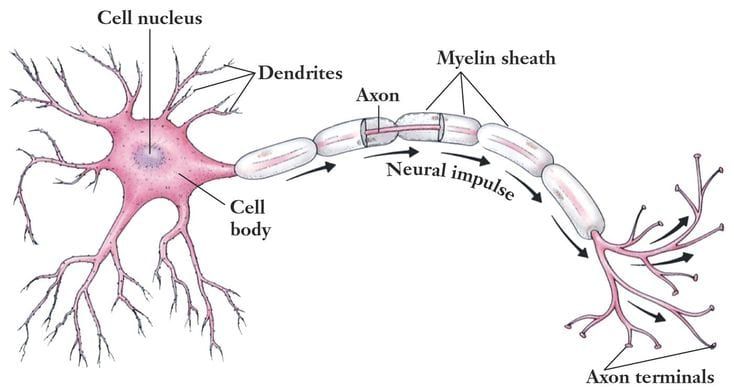
The diagram labels seven parts. Following the direction a signal travels: the dendrites, which receive the message; the cell body and the nucleus it holds; the axon leading away, wrapped in its myelin sheath; an arrow marking the direction of the neural impulse; and the axon terminals at the far end, where the message is handed on. They are the same seven parts listed above.
How neurons communicate
- Synapse — the meeting point between two neurons, with a gap between them
- Neurotransmitters — chemical messengers that cross that gap and bind to receptor sites on the receiving neuron
- Reuptake — neurotransmitters being reabsorbed by the sending neuron. They can also drift away, or be broken down by enzymes
The neurotransmitters page goes through the individual messengers one by one.
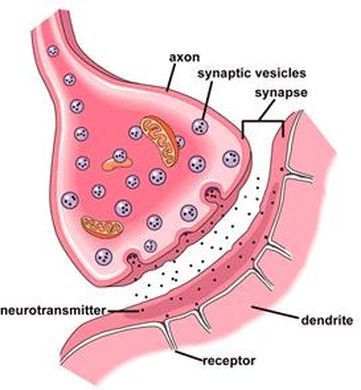
The diagram labels six parts: the axon of the sending neuron; the synaptic vesicles inside it holding the chemicals; the synapse, which is the gap; a neurotransmitter crossing it; the receptor it binds to; and the dendrite of the receiving neuron.
The nervous system
- Nervous system — the body's electrochemical communication network, made of the central and peripheral nervous systems
- Central nervous system (CNS) — the brain and spinal cord; the decision maker
- Peripheral nervous system (PNS) — gathers information and carries the CNS's decisions out to the rest of the body
- Nerves — bundles of axons forming cables that connect the CNS to muscles, glands and organs
Three kinds of neuron
- Sensory neurons carry incoming information from sensory receptors to the CNS
- Motor neurons carry outgoing instructions from the CNS to muscles and glands
- Interneurons sit between the two, processing information inside the CNS
Sources
- NINDS (National Institute of Neurological Disorders and Stroke) — Brain Basics: The Life and Death of a Neuron (neuron structure, glial cells, and how a signal travels from the dendrites along the axon)
- Neuroscience for Kids (University of Washington) — Glia — the other brain cells (the types and roles of glial cells)
- Khan Academy — Neurotransmitters and their receptors (the synapse and neurotransmitter material; the destination the old page's source link actually pointed at, whose visible label said MacMillan Higher Ed, which it was not)